![]() |
|
|
|
THE JAMES SMITHSON LIBRARY James Smithson, an 18th-century gentleman of science, included his library with his donation of $500,000 to found the Smithsonian Institution. The collection consists of about 110 titles - scientific monographs, literature, journals, and pamphlets. Inscribed and annotated volumes, including multiple copies of several of Smithson's own scientific publications, provide insights into intellectual networks of the period. Interestingly, many volumes remain in their original paper wrappers. The library thus represents a rich resource for biographers and bibliographers alike. HISTORY OF MUSEUMS & SCIENTIFIC COLLECTING
The books written by scientific collectors and classifiers from the 16th through the 18th centuries are the core of the Library's resources on museum history. Holdings include the works of Imperato, Aldrovandi, the Tradescants, Worm, Valentini, and many other classics in this field. The Library also holds later publications that catalog the collections of established museums, carrying their histories forward into the 19th century and the modern period. As
scientific collecting grew into a serious interest in the 1700s,
guides and manuals began to appear to assist collectors in properly
gathering, preparing, preserving, and transporting specimens. The
Library's holdings in this subject reflect the vigorous debate on
preservation methods through the 19th century, and include the Institution's
early series of instruction pamphlets for traveling naturalists.
Building on a base established by Spencer Baird, the Institution's
second Secretary (1878-1887), the bequest of the library of Alexander
Wetmore, sixth Secretary (1945-52), added significantly to our holdings
of collectors', preparators', and taxidermists' manuals. VOYAGES & EXPEDITIONS
The years 1750 to 1900 were a period of great scientific voyages. European royalty and governments, commercial enterprises such as the East India Company, and wealthy individuals sponsored expeditions that carried geographers, naturalists, and artists all over the world. They brought back countless specimens of plants, animals, and cultural artifacts. Naturalists in scientific academies, universities, museums, and botanical gardens studied and published descriptions and illustrations of the specimens, with special emphasis on those that were new to Western science. The designation of the Smithsonian in 1858 as the repository for all U.S. Governmental science collections brought the great specimen and artifact collections of the United States Exploring Expedition of 1838-1842 to the Smithsonian in its early years. From the 1830s through the 1880s Government-sponsored expeditions were sent out to map boundaries, to find routes for railroads, and to explore the geological history and resources of the West. The Institution's Spencer F. Baird ensured that these expeditions included properly equipped naturalists and artists. The
Library's collection of the official narratives and scientific reports
resulting from the expeditions and the study of their collections
is an important resource for researchers. Our holdings in some cases
include proof copies and volumes interleaved and annotated by the
Institution's scientific staff with museum accession numbers and
other data that connect the published descriptions of newly discovered
species with the actual specimens which are still part of the National
Museum of Natural History. ANTHROPOLOGY
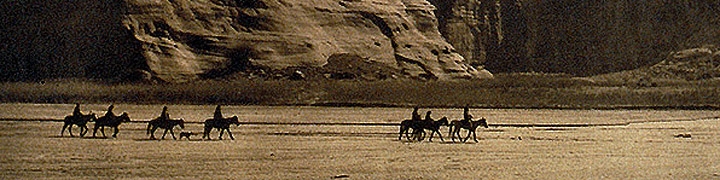
The rare-book collections are strong in narratives and scientific treatises by European voyagers to the Americas and other previously little-known parts of the world, which include descriptions and illustrations of the peoples they found living there. Recent donors such as Mrs. Ruth Lawson Webb and Mrs. Jefferson Patterson have contributed important items in these areas. The collections are particularly deep in 19th-century materials on North American cultures, and the recent purchase of the Wineland collection has added a number of rare works to those already available to researchers. Our holdings include multiple editions of many of the seminal texts and illustrated classics of this period, among them Catlin's numerous accounts of the customs and manners of Plains tribes, and McKenney & Hall's portraits of Native American tribal leaders. A complete set of Edward S. Curtis's North American Indian, donated by Mrs. E.H. Harriman, crowns this collection. Building on the work at the Smithsonian of James Constance Pilling, the great bibliographer of Native American languages, we hold a premier collection of missionary publications, often the first works to transcribe Native American languages into written form, and other early linguistic texts. Most recently, SIL purchased over a dozen such texts from the Sotheby's sale of the library of the eminent linguist Frank T. Siebert. Among our more striking holdings on the cultures of Central and South America are a significant number of published facsimiles of ancient manuscript codices. The magnificent 9-volume folio work on the Antiquities of Mexico by Edward King, Viscount Kingsborough, and the facsimiles published in the late 1880s by Joseph Florimond, the Duc de Loubat, constitute a principal resource for the study of pre-Columbian cultures of the Americas. The
collections also support research in physical anthropology, with
the bequest of Ales Hrdlicka's books an outstanding resource. The
works of earlier contributors in the search to understand human
diversity provide researchers with the historical literature underpinning
their current work. BOTANY
The usefulness of botanical books in taxonomic and systematic research depends to a great extent on the accuracy of their plant descriptions and illustrations. Among the many classic works in our collections, encyclopedic publications from the 1500s by botanists such as Mattioli and Fuchs, whose woodcut illustrations were based on first-hand observation of the plants, constituted a major advance in the accurate representation of natural objects compared to the static, stereotyped images handed down through centuries of manuscript copying. Through the 1700s and 1800s, as works by Catesby, Sloane, Jacquin and many others in the collection amply demonstrate, the skills of artists, engravers, etchers, and hand-colorists produced magnificent illustrations in support of scientific studies. The Cullman collections naturally include Linnaeus's classic studies on plant nomenclature and the many key works which developed and modified botanical classification systems during this rich period. Generous
gifts from botanists Albert Spear Hitchcock and Agnes Chase (Linnaeus's
works and early works on grasses); from John Donnell Smith (plants
of tropical America); and from science-bookdealer Harry Lubrecht
(again, Linnean works, and early North American botany) are among
the many that have built the Botany collection into an outstanding
research resource. MINERAL SCIENCES
Thanks to the Burndy donation in the Dibner Library, SIL's rare holdings in the mineral sciences begin with early printed texts of the classical and medieval natural philosophers - including Aristotle, Theophrastus, Strabo, Pliny, Avicenna, and Albertus Magnus - who speculated about the origin and nature of the physical world and the forces that form and change it. Agricola's pioneering works on mining and metals in the 16th century are held in several editions. Extensive holdings from the 18th and 19th centuries include the works of Cronstedt, Werner, Lyell, Murchison, and many others whose publications illuminated the earth sciences as they began to coalesce into a distinct field. The study of geological forces and the differentiation of minerals was well under-way by the mid-19th century, when the term "geology" assumed its modern meaning, the study of the earth's history. The historical controversy on how to classify minerals (by external characteristics or by internal structure) is fully represented in the natural-history rare collections, including the works of Hauy, Romé de l'Isle, Brogniart, and their contemporaries. The
library of James Smithson, a gentleman-scientist much interested
in minerals and their analysis and classification, is one of our
special collections in this subject. Our holdings in this field
have grown steadily through the years, augmented by the gifts of
George P. Merrill (1931) and the Paneth library on meteorites (1974),
among others. PALEONTOLOGY Paleontology forms a bridge between the sciences of biology and geology, since the presence and identity of fossils are linked to geological strata and the processes which form topographical features. Early scholars struggled to understand the nature of fossils and their position in the natural order. In organizing fossils in their "mineral" and "metal" cabinet collections, Renaissance philosophers like Aldrovandi, Imperato, Mercati, and Gesner, whose works are held in the SIL rare collections, fought their way through speculation, religious dogma, and folklore toward systems of scientific classification. In the late 17th century, thanks to the studies of scientists such as Steno, Scheuchzer, and Hooke, fossils were finally identified and accepted as traces or remains of animals and plants that have been preserved in the earth's crust. Paleontological knowledge - most importantly, the recognition that fossils are associated with specific geological layers of the earth and that many fossils represent species now extinct - was thereafter advanced in the classic works of Cuvier, Smith, Lamarck, and Brogniart. Darwin's theories on evolution and extinctions and Agassiz's works on fossils, glacial geology, and related subjects are among the significant 19th-century materials in the field. The
Cullman Library's holdings of works by the authors mentioned here
and by other scientists who made seminal contributions to paleontology,
enhanced through the purchase of the library of F.B.Meek and the
gifts of the libraires of Charles D. Walcott and Remington Kellogg,
support the systematic classification of fossils carried on by SI
scientists today. ZOOLOGY
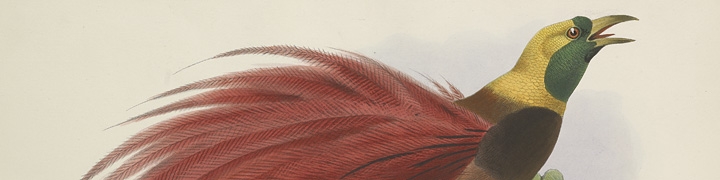
The works of subsequent explorers, travellers, collectors, and naturalists from the 16th through the 19th centuries slowly and with much trial and error built the modern conception of the natural sciences in which current researchers operate. Among the treasures in the Cullman is a strong collection of the works of Carl von Linné, known also as Linnaeus, the 18th-century Swedish naturalist who developed a system of nomenclature and classification for animals that was adopted throughout Europe and eventually the world. The natural-history rare collections hold many editions and translations of his masterwork Systema naturae [The system of nature], including the notable 10th edition of 1758 which remains the foundation of zoological taxonomy, and many of his other works. Fueled by great voyages of exploration and scientific expeditions, and based on Linnaeus's common language for the plants and animals being "discovered" by Western science, the explosion of zoological knowledge in the late 1700s and 1800s found expression in seminal scientific publications that are also beautiful picture books. Spectacular hand-colored plates of fishes, beetles, corals, birds, and innumerable other animals illuminate large folio volumes which are still regularly consulted by Smithsonian researchers for both their illustrations and their scientific descriptions. Our holdings are especially strong in illustrated works on birds, shells, and butterflies, among them the magnificent ornithological works of John Gould and Daniel Giraud Elliot, many of which volumes came to the Library through the gifts of distinguished collectors John H. Phipps (1980) and Marcia Brady Tucker (incorporating the library of Jonathan Dwight, Jr., 1969). Equally
important are technical or obscure works known only to the scientists
in any specific field. An indication of their depth can be gleaned
from the list of researchers at the Institution whose books enrich
the collections in the Cullman Library, by donation, bequest, or
purchase: Through
the Libraries' collections, current and future researchers benefit
from the generosity of many past generations of Smithsonian scientists
and private benefactors. MOLLUSKS CARD FILE Included with the transfer of rare books from the Mollusks divisional library was a 95-box set of hand-written cards listing generic and specific names given to species of recent and fossil mollusks in the scientific literature of the 18th and 19th centuries. The card file had been created by Gérard Paul Deshayes (1795-1875), the noted French malacologist and successor to Lamarck at the Muséum Nationale d'Histoire Naturelle in Paris, but the project appears to have been abandoned before his death. William Healey Dall (1845-1927), paleontologist with the U.S. Geological Survey and longtime honorary curator of Cenozoic Mollusks at the Smithsonian, purchased the cards from the executors of Deshayes' estate, with the intention of updating the file. Although it has not yet been determined by current researchers to what extent Dall actually updated the index, it remains a useful reference to the literature of molluscan species descriptions and contains names that have been overlooked by other nomenclators, such as Sherborn's Index Animalium. HORTICULTURE DECORATED BINDINGS The merger of the Horticulture Branch Library with the Botany Branch Library in 2003 prompted the transfer of Horticulture's collection of 19th-century decorated cloth bindings to the Cullman Library. The colorful, stylistically varied, and appealing covers demonstrate the decade-by-decade technological advances available to publishers through the 19th century and form a useful body of materials for bibliographers and historians. FURTHER READING On
Natural History Jacques
Brosse. Great Voyages of Discovery: Circumnavigators and Scientists,
1764-1843. New York: Facts on File Publications, 1983. Wilfrid
Blunt & William T. Stearn. The Art of Botanical Illustration.
New edition, revised and expanded: Woodbridge, Suffolk (UK): Antique
Collectors' Club, 1994. First published: London: Collins, 1950. S.
Peter Dance. The Art of Natural History. New York: Arch Cape
Press, 1990. First published: New York: Overlook Press, 1978. Roger
F. Pasquier & John Farrand, Jr. Masterpieces of Bird Art:
700 Years of Ornithological Illustration. New York, etc.: Abbeville
Press, 1991. (Many of the illustrations were photographed from books
in the SIL natural-history rare-book collections.) History
in the Service of Systematics: Papers from the Conference to celebrate
the Centenary of the British Museum (Natural History). London:
Society for the Bibliography of Natural History, 1981. Willie Ley. The Dawn of Zoology. Englewood Cliffs, N.J.: Prentice-Hall, 1968. On
the History of Books Warren
Chappell. A Short History of the Printed Word. Boston: Nonpareil
Books, 1980. First published: New York: Knopf, 1970. Elizabeth
Eisenstein. The Printing Press as an Agent of Change. Cambridge
(UK), etc.: Cambridge University Press, 1979. Phillip
Gaskell. A New Introduction to Bibliography. New York &
Oxford (UK): Oxford University Press, 1972. Adrian
Johns. The Nature of the Book: Print and Knowledge in the Making.
Chicago, London: University of Chicago Press, 1998. Douglas
McMurtrie. The Book: The Story of Printing and Bookmaking.
Third edition, revised: London, New York, Toronto: Oxford University
Press, 1943. First published as The Golden Book, 1927. Michael Olmert. The Smithsonian Book of Books. Washington, D.C.: Smithsonian Books, 1992. On
the Smithsonian & the National Museum of Natural History &
the Libraries James
Conaway. The Smithsonian: 150 Years of Adventure, Discovery,
and Wonder. Washington DC: Smithsonian Books; New York: Alfred
A. Knopf, 1995. Ellis
Yochelson. The National Museum of Natural History: 75 Years in
the Natural History Building. Washington: Smithsonian Institution
Press, 1985. The
Magnificent Foragers: Smithsonian Explorations in the Natural Sciences.
Washington DC: Smithsonian Exposition Books, 1978. Smithsonian
Institution Libraries. Rare Books and Special Collections in
the Smithsonian Institution Libraries. Washington: Smithsonian
Institution, 1995. |
| Return to Top |
|
|